


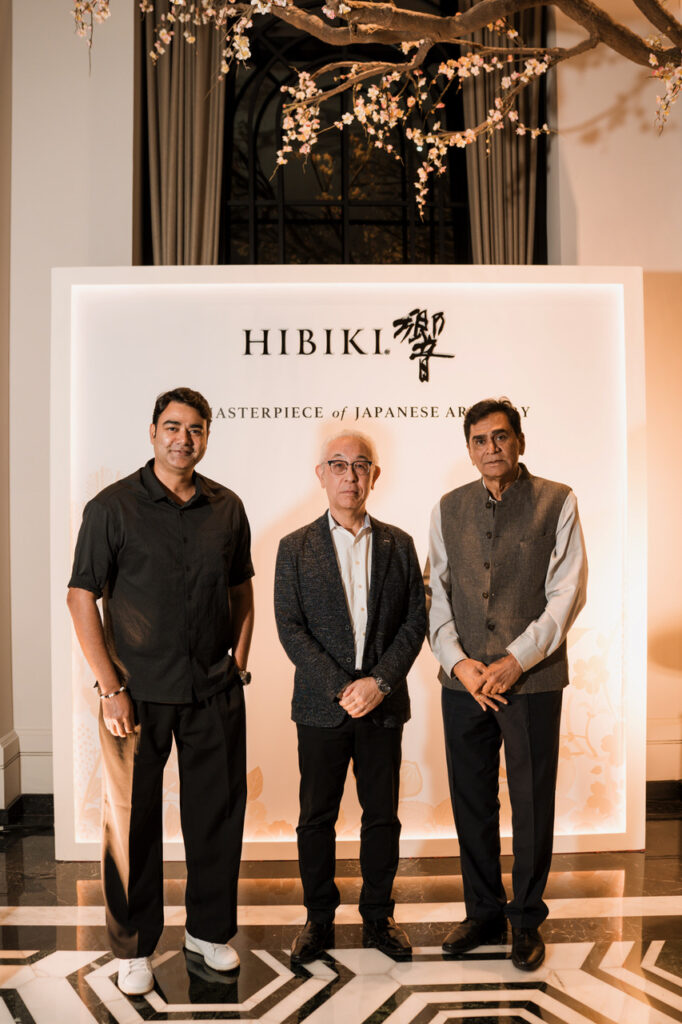
Masterclasses or whisky tastings often change the way you understand whisky. And Shinji Fukuyo’s recent masterclass in India, hosted by Beam Suntory, leaned firmly toward the latter – atleast when it comes to Japanese Whisky. As the Global Blending Lead for Suntory, Fukuyo isn’t here to sell a story — he in many ways is the custodian of Japanese whisky. And over the course of the evening, what emerged wasn’t just a lineup of single malts, but a deeper look into the philosophy that defines Japanese whisky – Harmony.
Building from Within
One of the most compelling starting points was a comparison with Scotland – the mecca of whisky’s that operates approximately over 130 distilleries. Naturally scotch thrives on exchange — components moving across distilleries to build blends across generations.
Unfortunately, Japan doesn’t have that luxury.
Which meant – Suntory built diversity internally. Its three distilleries — Yamazaki, Hakushu and Chita — don’t produce a singular house style. They produce multiple styles within each site, essentially creating an entire blending ecosystem in-house.
And therein lies the subtle, but crucial difference. Where Scotch often relies on collaboration, Japanese whisky relies on controlled variation.
Three Distilleries, One Philosophy
Each of Suntory’s distilleries plays a distinct role.
Yamazaki, founded in 1923 near Kyoto, is where richness and depth take shape. The climate lends itself to layered, evolving whiskies that ideally form the backbone of many blends.
Hakushu, set in the forests of the Japanese Southern Alps, offers blends contrast — lighter, fresher, with a restrained smokiness that feels integrated rather than imposed.
And finally there is Chita. The grain distillery, often understated, which produces clean, precise, blends that act as the structural glue — less about flavour dominance, more about balance.
And together, they function less like individual producers and more like components of a larger design.
The Casks
A blend is as good as its cask and if the Suntory distilleries provide the palette – then rightly so, casks always provide the texture. Fukuyo emphasised the role of different oak types — American, Spanish, French and Mizunara — not as standalone influences, but as tools of composition.
American oak brings familiarity: vanilla, coconut, softness. Spanish oak adds weight — dried fruits, spice, richness. French oak introduces structure and subtle tannin. And then there’s Mizunara – rare, difficult and unmistakable. Incense, sandalwood, a certain aromatic lift that feels almost intangible.
What stood out wasn’t just the variety, but the intent. Every cask choice is deliberate, designed to play a specific role in the final blend – and as the chief blender he is also responsible for assessing the stocks for the future – surely a tough task, considering the climate changes.
The Tasting
The tasting itself was a study in nuance. Each distinct than the other. For me the Mizunara cask stood apart — less about flavour intensity, more about character. It lingered differently, almost conceptually.
The session culminated in Hibiki Japanese Harmony, a blend that ties all these elements together. Multiple distilleries, multiple cask types, yet a seamless whole.
But what made the masterclass stand out wasn’t just the liquid, but the lack of theatrics. Fukuyo’s delivery was understated. No exaggerated claims, no over-polished storytelling. Just a clear articulation of process, intent and philosophy.
And that is a refreshing take – in an industry that often leans heavily on narrative – almost reflective of the whisky itself.

Harmony by Design
Perhaps the biggest takeaway from the session was that harmony isn’t accidental — it’s engineered – slowly, meticulously.
From distillation styles to cask selection, everything is built with the end blend in mind. Even the decision to create multiple whisky styles within a single distillery is part of that larger strategy.
And I think it is here that Japanese whisky diverges most clearly from Scotch. While Scotch often celebrates individuality — regionality, distillery character — all of which critical to its success.
Japanese whisky leans toward integration. Different approaches leading to different outcomes.
The Past
Fukuyo also touched upon Suntory’s first Japanese whisky – Shirofuda, launched in 1929 and deemed too smoky for the Japanese palate.
And much like the Japanese philosophy – Suntory adapted. It refined its style, moving toward balance and subtlety — principles that continue to define its whiskies today.
Finally
Honestly by the end of the session, what stayed wasn’t a single dram, but a way of thinking.
Japanese whisky, at least through Suntory’s lens, isn’t about bold statements. It’s about precision. About layering. About knowing when to stop. And in a category that often rewards intensity, that restraint might just be Suntory’s greatest strength.
- Bhavya Desai